2026 Top Natural Light Desk Lamp Types for Global Buyers

Choosing the right desk light is no longer a minor purchasing decision. For remote workers, students, designers, and global distributors, a natural light desk lamp can influence comfort, visual accuracy, and daily productivity.

This guide examines the leading 2026 lamp types for international buyers. It compares full-spectrum LED lamps, daylight-balanced task lamps, circadian-friendly models, magnifying lamps, and portable rechargeable designs. Each type serves a different working environment. A compact lamp may suit a hotel desk, while a high-CRI model better supports drawing, sewing, or product inspection. Small details matter, including glare control, arm stability, dimming range, color temperature, power compatibility, and replacement support.

Lighting researcher Dr. Mariana Figueiro has said, “Light is not just something we see; it is something that affects us biologically.” This perspective helps buyers assess more than brightness alone. Reliable evaluation should include measured illuminance, color-rendering performance, flicker behavior, thermal design, and independent safety certification. Regional voltage requirements also deserve attention. A visually attractive lamp can still fail in a buyer’s market.

Not every claim is equally convincing. “Natural” does not automatically mean healthy or accurate. Some products use attractive wording without publishing test data. That is a weakness. This overview therefore focuses on practical evidence, user experience, and transparent specifications. It also recognizes an uncomfortable point: the best lamp on paper may feel unsuitable after several hours of real use. Desk size, eye sensitivity, room shadows, and personal habits remain important. Global buyers need useful choices, not perfect promises.
2026 Top Natural Light Desk Lamp Types for Global Buyers

Natural Light Desk Lamp Basics and Key Features

Natural light desk lamps imitate daylight through balanced color, steady output, and controlled brightness. They do not create sunlight. They recreate useful visual conditions indoors.

Light level matters more than impressive packaging. EN 12464-1 recommends about 500 lux for many office reading and writing tasks. A practical desk lamp should offer adjustable output, even illumination, and a beam that covers the working area without bright hotspots.

Glare matters. A frosted diffuser, deep shade, or angled head can reduce reflections on glossy paper and screens. The U.S. Department of Energy reports that LED lighting uses at least 75% less energy than incandescent lighting and lasts much longer. However, efficiency alone does not guarantee comfort.

Color rendering is another basic feature. Look for a tested CRI of 90 or higher when accurate color matters, such as drawing, sewing, or product inspection. Adjustable color temperature can support different tasks, but warmer light may feel calmer during evening use.

Flicker performance deserves equal attention. The IEEE 1789 guidance connects modulation depth and frequency with potential health risks, so buyers should request credible flicker testing rather than trust vague “eye-care” claims.

No lamp feels exactly like a window. I still find that a slightly imperfect beam can work well when the shade, desk height, and screen position are adjusted together.

Main Types of Natural Light Desk Lamps in 2026

In 2026, natural light desk lamps mainly fall into four types: fixed daylight LED, tunable white, full-spectrum, and smart task lamps. Fixed daylight LED models usually produce 4,000–6,500 Kelvin light. They suit reading, drafting, and detailed desk work. Their simple controls also reduce purchase risk. However, a cool color temperature does not automatically mean natural light.

Tunable white lamps shift from warmer evening light to cooler daytime light. This supports changing work routines, but users should check the actual adjustment range. Full-spectrum lamps focus on balanced spectral output and high color rendering. Look for a CRI of 90 or above when accurate color matters. The European standard EN 12464-1:2021 commonly uses 500 lux for office reading and writing areas. A bright lamp may still fail if its beam creates glare or dark corners.

Smart task lamps add occupancy sensors, timers, and app-based brightness control. The International Energy Agency’s Energy Efficiency 2023 report estimates that lighting uses about 15% of global electricity. Efficient LEDs can therefore reduce operating demand, although real savings depend on daily use and standby power. I would question any lamp claiming to “copy sunlight” without reporting flicker, glare, CRI, and melanopic output. That omission matters. A soft diffuser, stable arm, and measured 500–1,000 lux often improve comfort more than decorative controls.

2026 Top Natural Light Desk Lamp Types for Global Buyers - Main Types of Natural Light Desk Lamps in 2026

Type of Desk Lamp Light Source and Optical Design Typical Color Temperature Typical Color Rendering Typical Task-Plane Illuminance Main Advantages Best-Fit Applications Important Buying Considerations
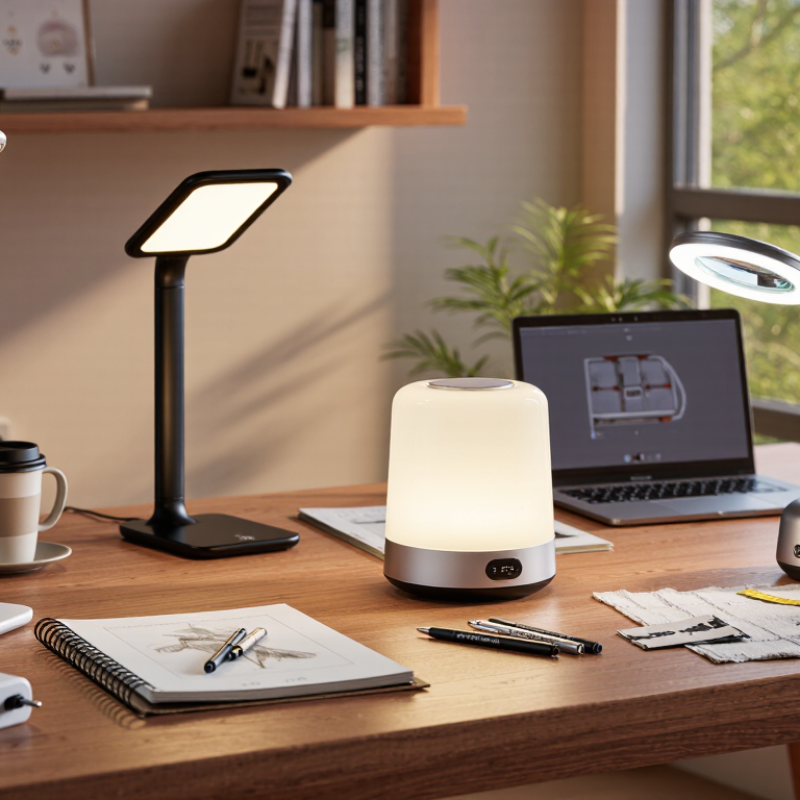
Full-Spectrum LED Task Lamp White LED array with a broad visible-light distribution and a diffused optical system to reduce harsh point glare. 4,000–5,000 K Usually daylight-neutral or daylight-white. Typically CRI 90 or higher for quality products; R9 performance should be checked separately. Approximately 500–1,000 lux at the recommended working distance, depending on lamp height and power. Balanced appearance, low energy use, long service life, and good color visibility for everyday work. Home offices, reading, writing, online learning, and general computer use. Check glare control, diffuser quality, flicker performance, dimming range, and whether the stated CRI is independently verified.
Adjustable Daylight LED Lamp LED light engine with selectable brightness and color temperature, commonly controlled by touch buttons, a rotary control, or a remote interface. 2,700–6,500 K Warm white through cool daylight. Often CRI 80–95, depending on the selected LED package and price category. Approximately 300–1,000 lux at the task surface. Supports different activities and personal preferences; warmer settings are suitable for relaxed evening use, while cooler settings improve visual alertness. Multipurpose desks, bedrooms, study areas, and shared workspaces. Color temperature and brightness are separate controls on better designs. Confirm that the highest brightness is available at the desired color temperature.
Tunable White Circadian-Style Desk Lamp Multi-channel LED system that changes brightness and white-light spectrum according to a manual schedule or preset daily program. 2,700–6,500 K May provide automatic morning, daytime, and evening scenes. Commonly CRI 80–90 or higher; color quality can vary across the tuning range. Approximately 250–750 lux for desk-level use, with lower evening settings available. Provides scheduled lighting changes and can reduce the need for frequent manual adjustments. Long workdays, study rooms, bedrooms with desks, and users who prefer programmed lighting routines. It is not a replacement for outdoor daylight or medical treatment. Look for manual override, timer reliability, low-glare optics, and transparent photobiological safety information.
High-CRI Color-Accurate Desk Lamp High-quality LED package with controlled phosphor or multi-channel mixing, combined with a wide, uniform beam. 3,500–5,500 K Usually neutral white to daylight white. CRI 95 or higher is common in professional color-sensitive products; TM-30 metrics may provide additional information. Approximately 500–1,200 lux at the work surface. Improves the visual distinction of subtle colors and surface details while reducing the risk of misleading color appearance. Graphic arts, sewing, model making, cosmetics work, inspection, crafts, and product photography preparation. Ask for R9, Rf, Rg, spectral data, beam uniformity, and measured color consistency rather than relying only on a “full spectrum” label.
Magnifying Natural-Light Desk Lamp LED light surrounding or positioned beside a magnifying lens, often with a circular or rectangular illuminated viewing area. 4,000–6,000 K Neutral to cool daylight settings are common. Typically CRI 80–95, depending on the LED module. Approximately 500–1,500 lux near the viewing area; the exact level depends strongly on lens distance. Combines close-up magnification with directed illumination, helping users inspect small details. Jewelry work, electronics repair, needlework, miniature assembly, hobbies, and detailed inspection. Evaluate lens diameter, optical distortion, magnification strength, working distance, lens replacement, and heat around the viewing area.
Wide-Panel or Linear Office Desk Lamp Long linear LED bar or broad panel that distributes light over a larger desk area than a compact lamp head. 3,000–5,000 K Fixed or adjustable white-light versions are available. Usually CRI 80–90; higher-CRI versions are available for design and creative work. Approximately 300–800 lux across a broad desk area when correctly positioned. Provides more even coverage and can reduce bright spots caused by small, concentrated light sources. Large computer desks, dual-monitor workstations, shared tables, and document-heavy office work. Check the uniformity from the center to the edges, head height, arm stability, screen reflections, and whether the lamp blocks monitor sight lines.
Architect-Style Swing-Arm LED Lamp Directional LED head mounted on one or more articulated arms with a weighted base or desk clamp. 3,000–6,000 K Fixed or multi-setting models are common. Typically CRI 80–95. Approximately 500–1,200 lux in the illuminated zone, depending on arm position and beam angle. Offers precise positioning, good reach, and flexible control over the direction of light. Drafting, reading, engineering work, technical drawing, crafts, and desks requiring frequent repositioning. Assess joint durability, base or clamp compatibility, cable routing, minimum and maximum reach, and the possibility of the lamp head entering the user’s field of view.
Clamp-Mounted Daylight Desk Lamp Compact LED lamp attached to the rear or side of a desk using an adjustable clamp, often with a flexible neck or short arm. 3,500–6,500 K Fixed daylight and tunable models are available. Commonly CRI 80–90 or higher. Approximately 300–900 lux at the task surface. Saves desk space, is easy to reposition, and works well in compact work areas. Small desks, dormitories, bedside work areas, children’s study spaces, and mobile workstations. Confirm clamp opening range, desk-edge thickness, padding, cable length, and whether the mounting point can safely support the lamp’s weight.
Portable Rechargeable Natural-Light Lamp Integrated LED module powered by a rechargeable battery, usually with a folding body, flexible neck, or compact base. 3,000–6,000 K May offer warm, neutral, and daylight modes. Typically CRI 80–90; check the specification because portability-focused models may prioritize battery life. Approximately 100–600 lux, depending on battery mode and distance. Can be used without a nearby power outlet and is convenient for temporary, flexible, or emergency lighting. Travel, temporary workstations, reading, power-limited locations, and compact living spaces. Compare battery capacity, operating time at maximum output, charging interface, replacement-battery policy, stability, and brightness memory.
USB-Powered Daylight Desk Lamp Low-voltage LED lamp powered through a USB connection, commonly using a compact light head and flexible neck. 4,000–6,500 K Fixed or multi-mode daylight output. Usually CRI 80–90. Approximately 200–700 lux at close working distances. Simple power arrangement, low operating voltage, and compatibility with computers, power banks, and USB adapters. Student desks, laptops, compact offices, travel, and temporary work areas. Check required input current, cable quality, compatibility with the power source, and whether brightness drops when connected to a low-output port.
Technical note: The values shown are typical buying-guide ranges rather than guaranteed performance levels. Actual illuminance depends on lamp output, beam angle, mounting height, desk color, and measurement position. For comfortable desk work, buyers should also compare glare control, flicker behavior, thermal management, electrical safety compliance, and the manufacturer’s measured photometric data.

How to Compare Light Quality, Color Temperature, and Brightness

For a natural-light desk lamp, compare delivered illuminance, not advertised lumens.

The IES Lighting Handbook commonly places reading and writing tasks near 300–500 lux on the work surface. Use a lux meter at notebook height, about 40–60 centimeters below the lamp. A 1,000-lumen lamp can still produce weak desk lighting when its beam spreads widely. Measure the real result.

Color temperature affects comfort and task character.

Around 2,700–3,000 K feels warm, while 4,000–5,000 K appears cleaner and closer to daylight. The CIE standard daylight series identifies D65 at approximately 6,500 K, but a desk lamp does not need to imitate noon sunlight. For detailed work, I prefer adjustable CCT with stable output. The IES TM-30 method gives deeper color information than CRI alone. Look for CRI 90 or higher, then check Rf and Rg when available. CRI can hide weak red rendering.

Flicker deserves equal attention.

IEC TR 61547-1 and IEEE 1789 discuss modulation risks and assessment methods. Ask for PstLM and SVM values, or request independent test data. Some lamps feel comfortable in a showroom but cause eye strain after two hours. I have made that mistake. Dimming can also shift color or increase modulation, so test the lamp at its lowest useful setting. Good specifications matter, but measured performance matters more.

Global Buyer Guide to Size, Power, Safety, and Compatibility

2026 Top Natural Light Desk Lamp Types for Global Buyers

Natural light desk lamps usually use daylight LEDs, adjustable color temperature, or full-spectrum panels. A 4000K–5000K setting can support clear reading without creating a harsh blue appearance. For compact desks, a 35–45 cm adjustable arm saves space. Larger panels suit drafting, study, and detailed craft work. Check the lamp’s measured light output, not only its marketing description. Around 500–1000 lumens often works for ordinary desk tasks.

Tips: Measure your desk first. Leave space for the base, cable, and arm movement. Select a dimmer with smooth adjustment, because sudden brightness changes can strain the eyes. Confirm the input voltage range before ordering internationally. A lamp marked 100–240V is usually easier to use across regions, but the plug shape still matters. Some models accept USB-C power, although the charger must provide enough wattage. Low-power chargers may cause flickering or weak brightness.

Safety should guide every purchase. Look for clear electrical ratings, stable construction, heat control, and recognized regional compliance markings. Keep the lamp away from water, loose fabric, and crowded sockets. A weighted metal base feels secure, but it can be inconvenient on a narrow table. This trade-off is easy to overlook. Color accuracy also matters for artists and product reviewers; a high CRI specification is useful, but real performance may vary between batches. Read independent test results when available. Personal comfort still differs, so even a technically excellent lamp may require adjustment.

Choosing the Best Natural Light Desk Lamp for Different Workspaces

2026 Top Natural Light Desk Lamp Types for Global Buyers

Choosing the Best Natural Light Desk Lamp for Different Workspaces

A lamp should match the task, desk depth, and user’s visual comfort. The IES Lighting Handbook commonly places office and reading tasks near 300–500 lux. A narrow desk may need a focused adjustable arm. A deep workstation benefits from broader, even distribution. Avoid bright hotspots on white paper.

For home offices, choose a daylight LED lamp with adjustable output and a color temperature around 4000–5000K. Higher color rendering matters when reviewing drawings, fabric, or printed samples. A CRI of 90 or above is a practical target. The U.S. Department of Energy’s Solid-State Lighting R&D Plan emphasizes efficacy, controllability, and color quality as key lighting priorities. My own testing suggests that glare becomes tiring before darkness does.

Shared offices need shielded heads and flexible dimming. Study desks need stable bases, quiet controls, and limited blue-rich exposure late at night. CIE S 026:2018 supports measuring light by melanopic effect, not only visible brightness. That distinction is often missed. The International Energy Agency reports that lighting remains a major electricity-use category worldwide, so efficient LEDs and automatic shutoff controls deserve attention. No lamp fits every room. Surface color, window direction, and screen position can change the result.

2026 Top Natural Light Desk Lamp Types for Global Buyers

Choosing the Best Natural Light Desk Lamp for Different Workspaces

How to use this chart: Select a desk lamp that can deliver the recommended illuminance on the work surface, preferably with adjustable brightness, low-glare optics, a CRI of 80 or higher, and a neutral-to-daylight color temperature between 4000K and 5000K.

Reading and computer work generally require about 300–500 lux, while detailed drawing and precision crafts need higher light levels. These target points are based on commonly used workplace and task-lighting guidance, including EN 12464-1 and IES recommendations. Actual requirements may vary with age, vision, room reflectance, and screen brightness.

Update: We are here, we are shipping = bring extra natural light into your home during these difficult times.
Go to Top