Top Preschool Classroom Seating Options for Global Buyers

Choosing the right Preschool Classroom Seating is not merely a purchasing decision. It shapes movement, attention, comfort, and daily classroom relationships. For global buyers, the best option must fit children, teachers, learning activities, local climates, and practical budgets.

Loris Malaguzzi, a leading Reggio Emilia educator, famously said, “The environment is the third teacher.” His words remain useful when comparing child-sized chairs, stackable stools, flexible cushions, benches, and low tables. Seating can invite children to collaborate, read quietly, build structures, or move safely between activities. A rounded chair may support group discussion, while lightweight stools can make room changes easier. Small details matter. Smooth edges matter. Stable feet matter.

Yet no product works perfectly in every preschool. A soft cushion may feel welcoming, but it can be difficult to clean in a busy room. Wooden seating may look warm, but its finish requires careful inspection. Plastic chairs can simplify maintenance, although some may feel cold or less personal. These trade-offs deserve honest attention. Sometimes, buyers focus too heavily on appearance. That is a mistake.

This guide examines leading Preschool Classroom Seating options for international purchasers. It considers ergonomics, durability, cleanability, storage, material quality, classroom flexibility, and supplier communication. Product dimensions should match children’s age and body size. Testing samples is wiser than trusting photographs alone. Buyers should also verify packaging, replacement parts, documentation, and after-sales support. A beautiful chair is not enough. Reliable seating earns its place through everyday use.
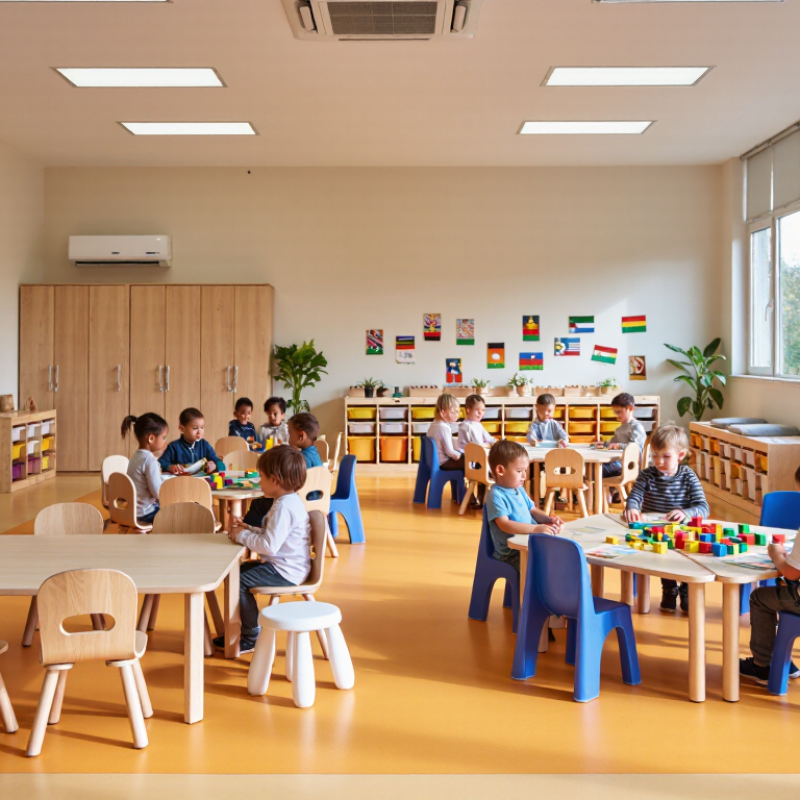
Top Preschool Classroom Seating Options for Global Buyers

Preschool Classroom Seating: Purposes and Core Design Principles

Preschool classroom seating should support movement, choice, and safe social interaction, not simply keep children still. The World Health Organization’s 2019 guidelines recommend at least 180 minutes of daily physical activity for children aged three to four, including 60 minutes of moderate-to-vigorous movement. Fixed rows can work against this need. Global buyers should consider lightweight chairs, low tables, floor cushions, and small stools that children can move safely during play, meals, and group activities.

Flexibility matters. OECD’s Starting Strong VI report highlights responsive interactions and intentional learning environments as foundations of early childhood quality. Seating should therefore allow face-to-face conversation, quiet concentration, and quick regrouping. Rounded edges, stable bases, washable surfaces, and clear circulation routes are practical priorities. Materials should also suit local humidity, cleaning routines, and replacement access. A beautiful seat is not useful if spare parts cannot arrive.

Child-sized furniture can encourage independence, but “one size fits all” is a weak assumption. Children differ in height, balance, sensory needs, and confidence. Test the fit. A low stool may help one child sit independently, while another may need back support or a wider base. I have found that observing children for several minutes reveals more than a catalogue photograph. Buyers should trial sample layouts, record awkward movement points, and revise the plan before ordering in volume.

Main Seating Options for Different Preschool Learning Activities

Top Preschool Classroom Seating Options for Global Buyers

Preschool seating should match the learning activity, not simply fill the room. For story circles, low semicircular benches help children see faces and picture books. For puzzles or drawing, child-sized tables with movable chairs support shared work. Lightweight stools and floor cushions allow quick changes between activities. They also reduce fixed seating habits.

The OECD’s Starting Strong V report links quality early learning with responsive environments and children’s active participation. This supports flexible layouts with clear walking space. The World Health Organization recommends 180 minutes of daily physical activity for children aged three to four, including 60 minutes of moderate-to-vigorous movement. Seating should not restrict that movement. Stackable chairs, soft mats, and open activity zones can help teachers switch from counting games to dance practice.

Material details matter for global purchasing. Rounded edges, stable bases, washable surfaces, and non-slip feet are practical safeguards. In my classroom observations, chairs that were too heavy stayed unused. A lighter chair worked better, though it sometimes moved noisily across hard floors. That flaw deserves attention. Buyers should check local floor conditions, child height ranges, cleaning routines, and replacement-part access before ordering. Adjustable tables can serve mixed-age groups, but complicated mechanisms may slow teachers down. Simple designs are often more dependable.

Top Preschool Classroom Seating Options for Global Buyers

Main Seating Options for Different Preschool Learning Activities

The chart uses a practical 1–5 suitability score, where 5 indicates that a seating option is highly suitable for the activity. Individual chairs support focused table work, low tables and cushions encourage collaborative play, stools provide flexible movement, benches work well for group activities, and carpeted open-floor areas are best for circle time and construction play.

Scores are planning-guide values based on common preschool classroom layouts and are intended for comparing functional seating options rather than representing brand or company performance.

How to Evaluate Safety, Comfort, Durability, and Cleanability

Top Preschool Classroom Seating Options for Global Buyers

When evaluating preschool seating, safety should guide every purchasing decision. Check rounded edges, stable legs, and smooth surfaces without sharp fasteners. Chairs should resist tipping when children lean sideways or stand briefly. I usually inspect a sample by pressing each joint and checking its underside. Small gaps can trap fingers, crumbs, or cleaning cloths. Ask suppliers for material declarations and test reports accepted in your target market. Requirements differ across countries, so one certificate may not prove global compliance.

Comfort also affects concentration and movement. Seat height should match children’s leg length, allowing both feet to rest naturally. A slightly curved back can support posture without restricting movement. Avoid overly soft cushions, which may hold moisture and become difficult to sanitize. During product reviews, I look for breathable surfaces and edges that do not press against small thighs. Children are not identical. Adjustable options can help, but complicated mechanisms may create new safety concerns.

Durability depends on daily use, not showroom appearance. Test welds, joints, coatings, and protective floor glides before ordering large quantities. Ask how the seat performs after repeated cleaning with approved classroom disinfectants. Wipeable plastic is practical, while porous fabric needs stronger maintenance controls. I once underestimated the effect of sand and wet clothing on chair surfaces. That mistake changed my inspection checklist. Buyers should request replacement parts, cleaning instructions, packaging details, and a realistic service-life estimate before approving production.

Global Buyer Guide to Materials, Sizes, Standards, and Suppliers

Top Preschool Classroom Seating Options for Global Buyers

For global buyers, preschool seating should balance safety, comfort, durability, and easy maintenance. Common choices include molded polypropylene, solid wood, plywood, and laminated board. Polypropylene resists moisture and frequent cleaning. Wood feels warmer but needs sealed edges and stable joints. Avoid sharp corners, exposed screws, and coatings with unclear chemical information. A smooth surface matters during daily wiping.

Size must match children, tables, and classroom movement. Seat heights around 26 to 35 centimeters may suit different preschool age groups, but actual child measurements are more reliable. Check seat depth, backrest support, and leg clearance together. Standards vary by destination, so ask suppliers about applicable testing for strength, stability, flammability, surface coatings, and chemical safety. Request current laboratory reports, material declarations, and production inspection records. A certificate without traceable details deserves questions.

Tips: Order samples before bulk purchasing. Test wobble, edge comfort, stacking, and cleaning resistance in a real classroom. Confirm carton dimensions, pallet loading, minimum order quantity, lead time, replacement parts, and after-sales procedures. Supplier audits should review factory equipment, worker practices, quality controls, and packaging. Small details matter. A visually attractive chair can still be uncomfortable after twenty minutes. Buyers sometimes focus too heavily on price, then discover uneven colors or delayed shipments. That mistake is avoidable, though no inspection plan is perfect.

Top Preschool Classroom Seating Options for Global Buyers - Global Buyer Guide to Materials, Sizes, Standards, and Suppliers
Seating Option Typical Use Recommended Seat Height Common Dimensions Suitable Materials Key Safety Features Relevant Standards and Compliance Checks Best Supplier Type
One-Piece Preschool Chair Story time, drawing, meals, group activities, and general classroom use. 260–310 mm for most preschool users; confirm against children's popliteal height. Seat width: 280–350 mm
Seat depth: 250–320 mm
Overall height: 450–600 mm
Injection-molded polypropylene, solid beech, laminated plywood, or powder-coated steel with a shaped seat. Rounded edges, stable four-leg base, non-slip feet, smooth surfaces, and no accessible pinch points. Check EN 1729-1 and EN 1729-2 where applicable; verify local requirements for chemical emissions, lead, phthalates, and flame performance. Educational furniture manufacturer or contract furniture supplier with child-product testing capability.
Stackable Plastic Chair Flexible classrooms requiring quick cleaning, frequent rearrangement, and compact storage. 260–310 mm. Seat width: 280–340 mm
Seat depth: 260–310 mm
Stacking height: commonly 6–12 chairs
UV-stabilized polypropylene or reinforced recycled plastic designed for indoor use. Wide footprint, controlled stacking geometry, rounded corners, textured anti-slip feet, and no sharp molding flash. Request load, stability, durability, and flammability test reports; check material restrictions under the destination market's regulations. Injection-molding supplier or school-furniture wholesaler able to provide color and packing options.
Wooden Classroom Chair Warm, traditional classrooms, reading corners, and long-duration seated activities. 260–310 mm. Seat width: 280–350 mm
Seat depth: 260–320 mm
Overall height: 450–600 mm
Solid hardwood, birch plywood, or beech plywood with water-based coating. Rounded and sealed edges, recessed fasteners, reinforced joints, low center of gravity, and moisture-resistant finish. Check EN 1729 dimensions and safety provisions; request coating emissions and durability documentation for indoor educational use. FSC- or PEFC-chain-of-custody woodworker, school-furniture factory, or audited woodworking supplier.
Adjustable Chair Mixed-age classrooms, inclusive learning spaces, and facilities seeking longer service life. Approx. 260–380 mm, depending on the adjustment range. Seat width: 300–380 mm
Seat depth: 280–360 mm
Adjustment increments: commonly 20–30 mm
Steel or aluminum frame, molded seat shell, and replaceable polypropylene or polyurethane components. Lockable adjustment mechanism, tamper-resistant hardware, anti-tip base, covered moving parts, and stable feet. Check EN 1729 size compatibility, stability, mechanical durability, and pinch-point protection; obtain instructions in the destination language. Contract school-furniture manufacturer with engineering support and spare-parts availability.
Low Lounge Chair Reading areas, quiet zones, one-to-one support, and informal discussion spaces. 220–280 mm. Seat width: 350–500 mm
Seat depth: 350–450 mm
Back height: 450–650 mm
High-density foam, polyurethane-coated upholstery, woven polyester, or cleanable vinyl over a plywood frame. Low center of gravity, sealed seams, rounded frame, tip resistance, wipe-clean surfaces, and non-toxic finishes. Check upholstery abrasion, seam strength, flame performance, chemical emissions, and local hygiene requirements. Commercial upholstery supplier or educational soft-seating manufacturer offering replaceable covers.
Floor Cushion or Modular Soft Seat Circle time, sensory areas, flexible seating, and collaborative floor activities. Floor level to approximately 100 mm. Round: 300–450 mm diameter
Square: 300–450 mm per side
Thickness: 50–120 mm
Polyurethane foam, polyester fiberfill, cotton-polyester fabric, coated textile, or wipe-clean PVC-free upholstery. Non-slip underside, concealed zipper, washable cover, low-allergen filling, and no detachable small parts. Verify textile flammability, colorfastness, seam durability, restricted substances, and cleaning-cycle performance. Textile and foam converter or soft-play supplier with washable-cover production.
Bench Seating with Backrest Group tables, waiting areas, collaborative work, and shared reading spaces. 260–310 mm. Seat depth: 280–360 mm
Length: 600–1,500 mm
Seating capacity: approximately 2–4 children
Birch plywood, solid hardwood, laminated board, or steel frame with a sealed wood or plastic seat. Anti-tip design, rounded corners, reinforced joints, non-slip feet, and adequate spacing from adjacent furniture. Check furniture stability, static load, edge impact, mechanical durability, and EN 1729 compatibility where relevant. School-furniture factory or custom project supplier with batch inspection and load-testing records.
Wobble or Active Sitting Stool Short-duration activities, movement-based learning, and alternative seating zones. 250–330 mm. Seat diameter: 250–350 mm
Base diameter: 300–400 mm
Overall height: 250–350 mm
Molded polypropylene, rubberized base, plywood, or foam-padded seat with a durable cover. Controlled tilt range, broad anti-slip base, rounded profile, stable recovery, and no exposed moving mechanism. Request stability, fatigue, load, and tip-resistance testing; confirm that the product is suitable for the intended age group. Specialist active-seating manufacturer or educational equipment supplier with tested motion mechanisms.
Saddle-Style or Ergonomic Stool Art stations, maker activities, high-low tables, and supervised short sessions. 260–380 mm, preferably adjustable for different work surfaces. Seat width: 280–380 mm
Seat depth: 220–320 mm
Base diameter: 300–450 mm
Polypropylene shell, molded polyurethane, plywood, or coated steel with a wipe-clean surface. Stable base, rounded saddle edges, non-slip feet, concealed adjustment components, and controlled seat movement. Check stability, mechanical endurance, material safety, and age appropriateness; avoid unverified products for unsupervised use. Ergonomic furniture supplier or educational equipment manufacturer with product testing documentation.
Global buying note: Seat height should be selected using the child's popliteal height rather than age alone. Before placing an order, request dimensional drawings, maximum user weight, stability and durability test reports, material declarations, cleaning instructions, packaging details, spare-parts policy, and destination-market compliance documents. Standards and legal requirements vary by country and should be verified by the importer or local compliance specialist.

Planning Flexible Seating Layouts for Diverse Preschool Environments

Top Preschool Classroom Seating Options for Global Buyers

Planning flexible seating starts with observing children, not filling a room with fashionable furniture. Low tables, stackable chairs, floor cushions, and stable wobble stools support different postures. Keep clear pathways between activity zones. A quiet corner may need a soft mat, while a drawing table needs firm seating and elbow support. OECD’s Starting Strong VI report identifies responsive, child-centered environments as key elements of quality early childhood education. This supports layouts that adapt to children’s needs.

Global buyers should check dimensions, surface durability, cleaning requirements, and material safety documentation. UNICEF reported that 175 million children lacked access to pre-primary education globally in 2019. Therefore, seating must work across varied budgets and classroom sizes. Modular pieces can reduce replacement costs. However, flexibility is not automatically better. A wobble stool may help one child and distract another. I have seen attractive layouts become crowded after only three activity stations.

Tips: Begin with two seating types, then observe movement for one week. Record where children sit, how often they leave, and which areas cause conflict. Add visual labels for storage. Leave space for mobility devices and adult supervision. Avoid placing soft seating beside busy walkways. Review the plan with teachers and caregivers, because a layout that looks efficient on paper may feel uncomfortable in practice.

Update: We are here, we are shipping = bring extra natural light into your home during these difficult times.
Go to Top