2026 Best Round Plastic Nursery Pots for Wholesale Buyers?
Choosing the right round plastic nursery pot can affect more than a plant’s appearance. It shapes bench spacing, shipping efficiency, watering routines, and the number of damaged containers a nursery must replace. For wholesale buyers planning 2026 orders, a low unit price is only one part of the calculation. Rim strength, drainage openings, stackability, material consistency, and dependable sizing deserve close review.
Horticulturist Dr. Linda Chalker-Scott writes about practical plant and container care. A responsible paraphrase of her evidence-based approach is: “Choose a container for the plant’s needs, not appearance alone.” This is a paraphrase, not a verbatim quotation about nursery pots. That distinction matters. Buyers should also ask suppliers for dimensions, wall-thickness details, sample pots, and clear information about resin and color options. A sample filled with damp growing media can reveal flex that a product sheet may not show.
Details matter.
The best pot depends on the crop, production system, and handling conditions. A lightweight pot may cut freight weight, yet feel less stable on a busy cart. A deeper profile may suit some root systems, but use more shelf space. There is no universal winner. Even experienced buyers can miss small inconsistencies between batches, so checking samples and written specifications is sensible. This guide compares common styles and purchasing considerations to help wholesale buyers make a more informed choice. It also leaves room for a practical truth: supplier performance can vary, and a first order is not proof of long-term consistency.
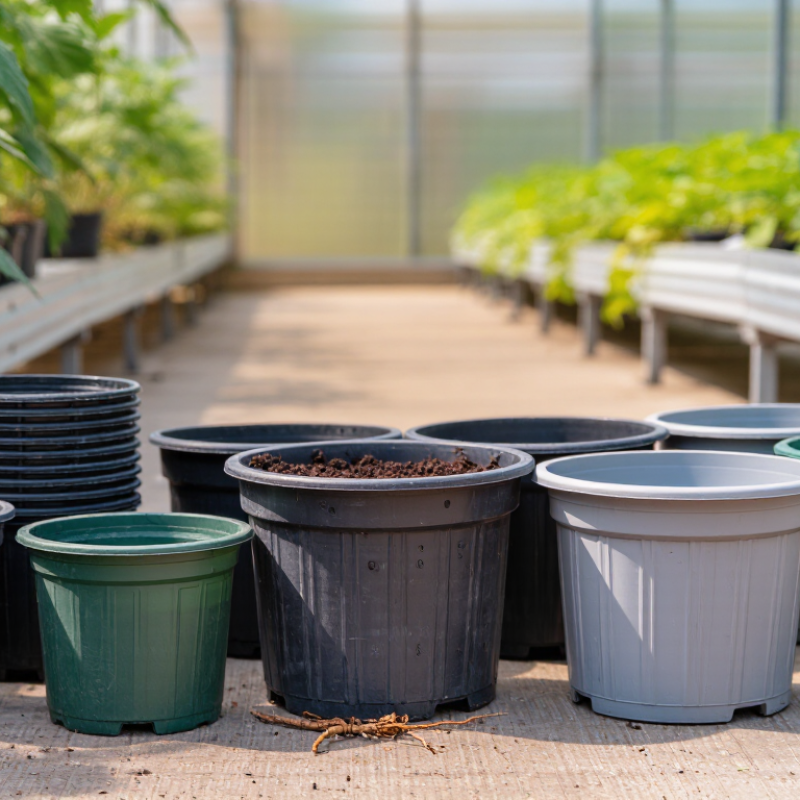
Round Plastic Nursery Pots: Purpose and Common Uses
Round plastic nursery pots hold seedlings, cuttings, and young plants as they develop stronger root systems. Their rounded walls give roots room to spread, while drainage holes let excess water escape after irrigation. That detail matters. In a greenhouse, a pot that drains slowly can leave the growing mix soggy between watering cycles. Buyers should check hole size and placement, since both affect drainage and handling.
These pots are common in commercial nurseries, garden centers, landscaping projects, and seasonal plant production. Growers use them for herbs, flowering annuals, shrubs, and small trees before moving plants into larger containers or garden beds. Their shape also fits standard trays and shelving, which can make bench space easier to organize. They stack neatly when empty. Still, not every pot nests well; a close-fitting stack may take extra time to separate during busy planting days.
For wholesale orders, compare rim strength, wall flexibility, and the range of available sizes. A pot that looks sturdy on a pallet may flex when filled with damp soil, especially if workers carry it by the rim. Reuse can reduce waste, but only when pots remain intact and are cleaned appropriately between crops. It is easy to overlook that step when work gets rushed.
2026 Best Round Plastic Nursery Pots for Wholesale Buyers? - Round Plastic Nursery Pots: Purpose and Common Uses
| Pot Type or Size Range | Typical Dimensions* | Purpose and Common Uses | Wholesale Buying Considerations |
| Propagation pot | About 2–3 in. (5–8 cm) diameter | Starting rooted cuttings, seedlings, and small plugs before transplanting. | Check drainage-hole design, tray compatibility, and whether pots can be nested efficiently. |
| Small production pot | About 3–4 in. (8–10 cm) diameter | Growing herbs, bedding plants, compact perennials, and young transplants for retail or further production. | Compare rim strength and dimensions with automated filling, potting, and handling equipment. |
| Medium nursery pot | About 5–7 in. (13–18 cm) diameter | Common for established perennials, foliage plants, vegetables, and shrubs in early growth stages. | Review wall thickness, stackability, and pot stability when filled and watered. |
| Large nursery pot | About 8–12 in. (20–30 cm) diameter | Holding larger shrubs, young trees, patio plants, and specimens that need more root space. | Check load capacity, handling requirements, pallet dimensions, and freight volume. |
| Deep round pot | Diameter varies; depth is greater than a standard pot of similar width | Used for plants with deeper root systems and for production where extra vertical root space is needed. | Confirm internal depth and usable volume; outside dimensions alone may not indicate root space. |
| Rigid reusable pot | Available across multiple diameters and depths | Repeated nursery or greenhouse production cycles where pots are collected, cleaned, and reused. | Assess durability, cleaning needs, return logistics, and compatibility with existing production systems. |
| Thin-wall production pot | Available in common small and medium sizes | Lightweight container for high-volume growing, short-to-medium production cycles, and retail-ready plants. | Balance unit cost and shipping efficiency against the rigidity required for filling and transport. |
*Dimensions are general examples, not standardized trade specifications. Actual diameter, depth, capacity, and fit vary by pot design and supplier; verify product measurements and sample fit before placing a bulk order.
Materials and Features of Round Plastic Nursery Pots
Round plastic nursery pots are commonly molded from polypropylene (PP) or high-density polyethylene (HDPE). PP tends to hold its shape well, while HDPE can absorb knocks and flex without cracking as easily. Actual performance depends on resin grade, wall thickness, and molding quality. Check sample pots when empty and filled; a thin base may bow under wet growing media. Small details matter.
PlasticsEurope’s Plastics—The Fast Facts 2024 reports global plastics production of 413.8 million tonnes in 2023. That figure describes the wider plastics industry, not nursery-pot demand, but it highlights why resin sourcing and recycled content deserve scrutiny. Ask suppliers for resin specifications, recycled-content documentation, and UV-weathering test results. Pots exposed to direct sun may become brittle sooner without suitable UV stabilization. Drainage holes should release excess water without weakening the base, and rolled rims make handling easier with gloves. More holes are not always better. They can dry small root balls too quickly. I would compare pots using the same media, watering schedule, and sunlight before placing a large wholesale order. Test data helps, but real growing conditions still matter.
Choosing Pot Sizes, Drainage, and Stackability
For wholesale buyers, pot size affects more than plant fit. It shapes growing time, shipping volume, and shelf space. USDA’s 2022 Census of Agriculture reported more than $18 billion in U.S. greenhouse, nursery, floriculture, and sod sales. That scale makes consistent specifications useful, but one size rarely suits every crop. Match pot diameter and depth to the root ball and expected growing period; undersized pots dry quickly, while oversized pots can waste mix and storage space.
Check drainage before comparing unit prices. Look for multiple open holes that release water without letting growing media spill freely. A raised base can help keep holes clear on flat benches. Ask suppliers for actual rim diameter, height, volume, and nesting depth—not just nominal gallon size. Dimensions can vary between molds, and that difference may disrupt automated filling or packing. There is no perfect standard. Test samples with your own media and irrigation routine.
Tips: Stack a full sample column, then separate the pots by hand. Check for wedging, cracked rims, and excessive wobble. Compare nested height per 100 pots to estimate warehouse and freight needs. A tighter stack saves space, but overly tight nesting slows unpacking; that trade-off is easy to underestimate.
Comparing Quality, Cost, and Sustainability in 2026
For wholesale buyers, a round nursery pot’s unit price is only part of its cost. Check rim strength, drainage-hole consistency, and whether nested pots separate cleanly after shipping. A brittle rim can split during filling; uneven drainage can leave water pooled beneath roots. Ask suppliers for wall-thickness tolerances and batch samples, then test them with your actual growing medium. Small details matter.
Sustainability needs equally careful comparison. The U.S. EPA reported that plastic containers and packaging generated 14.5 million tons of waste in 2018, with 13.6% recycled. OECD’s Global Plastics Outlook estimated that just 9% of global plastic waste was recycled in 2019. Neither figure measures nursery pots alone, but both show why end-of-life claims deserve scrutiny. Compare recycled content, local collection options, and verified material disclosures. Recycled resin can reduce virgin plastic use, yet inconsistent feedstock may affect color or impact strength. I would not treat recycled content as an automatic win. It is one factor, not the whole decision. For 2026 purchasing, compare landed cost per usable pot, including freight, breakage, and replacement rates. A cheaper pallet may cost more in practice.
Evaluating Suppliers, Orders, and Shipping for Wholesale Buyers
2026 Best Round Plastic Nursery Pots for Wholesale Buyers?
For wholesale buyers, supplier evaluation should begin with repeatability, not the lowest unit price. Ask for pot dimensions, material details, drainage-hole specifications, and written tolerances. Then inspect samples for thin rims, uneven bases, and pots that fail to nest cleanly. Small defects can slow filling lines. Request a production sample, not only a showroom piece, and confirm whether colors or resin blends change between runs. I would also verify reorder lead times; a good first shipment does not guarantee a reliable second one.
Order size should match actual growing schedules and storage space. The USDA’s 2023 Floriculture Crops Summary reported $6.7 billion in U.S. floriculture sales, showing the scale of the market these containers serve. It does not predict demand for any single pot size, so buyers should use their own crop plans. Compare minimum order quantities with pallet counts, and ask how many pots fit per pallet. A low price can lose its appeal when excess inventory blocks a greenhouse aisle.
Shipping deserves a written cost breakdown. The 2024 CSCMP State of Logistics Report estimated U.S. logistics costs at $2.3 trillion, or 8.7% of GDP, in 2023. Freight can materially change landed cost, especially for bulky, lightweight pots. Confirm pallet dimensions, protective wrapping, delivery appointment rules, and responsibility for damage before paying. Test a small order if possible. It adds work, but may expose a packing problem early. I would not assume every nested stack arrives perfectly aligned.
