A sleep light can look excellent in a product photo and still disappoint in a dark bedroom. A bright charging indicator, uneven dimming, or an awkward timer can turn an attractive sample into a customer complaint. Details matter. For wholesale buyers comparing options in 2026, the strongest products deserve evaluation beyond color temperature and packaging. This introduction frames the buying priorities: nighttime usability, measurable lighting performance, product safety documentation, and consistent supply.
“Light at night is part of the reason so many people don’t get enough sleep,” says Harvard sleep researcher Stephen Lockley. His observation supports a practical purchasing principle: evaluate how much light reaches the user, and when. Warm amber output may suit nighttime use, but color alone cannot establish whether a product supports sleep. Ask suppliers for spectral measurements, minimum brightness readings, and clear explanations of testing conditions. Avoid treating “blue-light-free” or “sleep-enhancing” labels as proof. Evidence matters. A useful sample review includes bedside operation, timer accuracy, surface temperature, and visibility at the lowest setting.
Wholesale decisions also depend on practical realities: minimum order quantities, replacement policies, packaging durability, and delivery reliability. Request documentation relevant to your destination market, and confirm that it matches the exact model being purchased. Some compromises remain unavoidable. A rechargeable design offers portability but adds battery maintenance and eventual replacement concerns. Even a promising sample cannot establish consistency across an entire production batch. The best sleep light shortlist should therefore reflect documented performance, realistic claims, and the needs of actual customers.
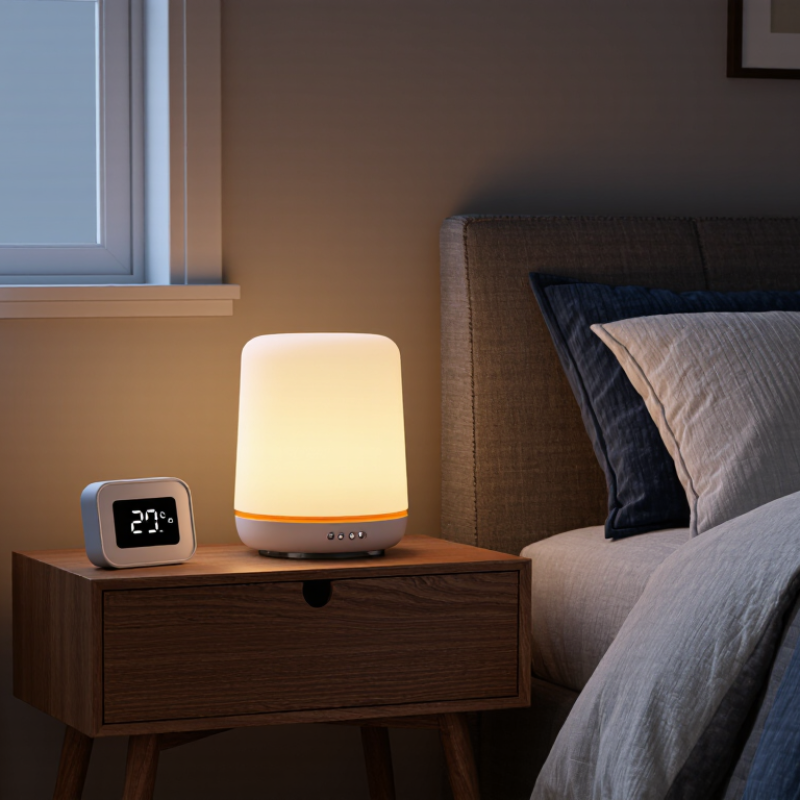
Sleep lights serve different jobs, so wholesale ranges should reflect how bedrooms are actually used. Dimmable bedside lamps suit reading, winding down, and finding essentials without switching on ceiling lights. Look for low minimum brightness, shielded LEDs, and controls users can locate in darkness. Warm white settings around 2200–2700K can create a softer evening atmosphere. Amber models offer another option, although color alone does not guarantee better sleep. Brightness matters. A lamp that looks gentle in a showroom may feel glaring beside a pillow.
Motion-activated night lights help illuminate routes between beds, doorways, and bathrooms. Position them below eye level, with light directed toward the floor. Check sensor sensitivity and shutoff timing before ordering large quantities. An overly sensitive sensor may trigger whenever someone turns over in bed. Portable rechargeable lights suit shared bedrooms and nighttime caregiving, where focused illumination can reduce disturbance. Test the lowest setting. Published battery runtime may reflect dim operation rather than the brightness customers actually use.
Sunrise-style lights gradually brighten before a scheduled wake time, while fading lights can support a consistent bedtime routine. Neither feature should be marketed as a treatment for insomnia. For wholesale selection, compare dimming smoothness, timer accuracy, charging instructions, and documented safety compliance for each destination market. Request samples and check whether settings survive a power interruption. Decorative projection lights deserve closer evaluation: moving patterns may entertain children but distract them at bedtime. A simpler, static setting may prove more practical.
Use published light-exposure recommendations to guide bedroom lighting purchases. The chart compares recommended daytime, evening, and sleeping-environment targets for healthy adults. These are exposure benchmarks, not product test results or brand rankings.
Choosing light types: Dimmable bedside and reading lamps can support evening routines when their output and placement keep exposure at the eye low. Low-mounted, shielded night lights can support nighttime navigation while limiting light reaching the eyes. Warm or amber light may help reduce melanopic exposure, but color temperature alone cannot confirm that a product meets these targets.
Reading the chart: Daytime exposure should reach at least 250 lux melanopic EDI; exposure during the three hours before bedtime should stay at or below 10 lux melanopic EDI; and the sleeping environment should stay at or below 1 lux melanopic EDI. Melanopic equivalent daylight illuminance measures light's stimulation of melanopsin-sensitive cells and differs from ordinary photopic lux. The logarithmic axis makes these different exposure levels easier to compare.
Source: Brown et al. (2022), “Recommendations for daytime, evening, and nighttime indoor light exposure to best support physiology, sleep, and wakefulness in healthy adults,” PLOS Biology. The 2026 heading identifies the buying-guide edition; the benchmark values come from this published expert consensus.
For 2026 wholesale buying, sleep lights need more than a warm glow. Brightness should match the room and viewing distance. A 2022 expert consensus in PLOS Biology recommends no more than 10 lux melanopic EDI during the three hours before bedtime. During sleep, it recommends no more than 1 lux melanopic EDI at eye level. These describe light reaching the eyes, not a lamp’s advertised lumen output. Placement matters. A bedside light can feel gentle until its exposed LEDs face someone lying down.
Color temperature helps buyers compare products, but it cannot establish biological suitability alone. Two 2700 K lights can produce different melanopic exposure because their spectra differ. The CIE S 026:2018 standard provides metrics for assessing these effects. Request spectral data alongside dimming measurements. For samples, compare the lowest setting against white bedding and pale walls. Reflections can make an apparently modest light uncomfortable. Warm is insufficient.
Controls determine whether suitable settings remain practical at midnight. Look for tactile buttons, gradual dimming, and a remembered low setting after switching off. Test whether the first press restores a bright default. That detail deserves attention. Timers can reduce unnecessary exposure, although automatic shutoff may frustrate someone reading in bed. There is no perfect control layout; wholesale samples should reveal which compromises users will actually encounter.
For wholesale buyers comparing sleep lights in 2026, useful specifications should describe performance at the bedside. Check the lowest brightness setting, not just maximum output. A light that dims only to 20 lumens may still feel intrusive beside a pillow. Request measured output, color temperature, and dimming range for each model. Warm amber light deserves consideration, but color alone does not establish suitability for bedtime. Placement matters. Compare samples at the same distance from a wall, checking glare, uneven illumination, and visible flicker during dimming.
Evaluate controls through ordinary nighttime tasks: finding the switch, changing brightness, and restarting after a power interruption. Small details count. An illuminated button can become distracting even when the main light is off. Ask whether timers, memory settings, and touch controls behave consistently across samples. For rechargeable models, request runtime measurements at a stated brightness rather than accepting an unexplained battery-life claim. Review safety documentation relevant to your destination market, including matching model numbers and identifiable testing laboratories. Avoid treating a certification logo on packaging as sufficient evidence.
Purchasing decisions also depend on carton dimensions, minimum order quantities, replacement policies, and lead times. Request packaging samples to assess protection around charging ports, switches, and shades. A low unit price can lose its appeal when fragile packaging increases returns. Still, a comparison spreadsheet can overlook awkward controls or a base that slides across polished furniture. Sample reviews remain imperfect, especially when production batches vary. Include written acceptance criteria for brightness consistency, cosmetic defects, and functional checks in the purchase agreement.
| Comparison Criterion | Technical Facts and Reference Data | What Wholesale Buyers Should Compare | Evidence to Request |
|---|---|---|---|
| Light Color and Spectrum | Warm-white light is commonly described by correlated color temperature (CCT), measured in kelvin (K). White light at 2700 K appears warmer than white light at 4000 K. Saturated red light is better described by its spectrum or peak wavelength than by CCT. | Compare available white, amber, and red modes. Review spectral output alongside brightness; a color name or CCT value alone does not establish a light's effect on sleep. | Spectral power distribution, measured CCT for white modes, and wavelength specifications for colored modes. |
| Minimum Brightness and Dimming | Lumens (lm) measure total luminous flux. Lux (lx) measures illuminance at a surface; 1 lx equals 1 lm/m². A dimming percentage does not specify the actual light reaching a user's eyes. | Compare the lowest usable setting, adjustment smoothness, and illuminance at a defined bedside position. Check for abrupt jumps or a minimum setting that remains too bright. | Minimum and maximum lumen output, lux measurements with distance and orientation stated, and a sample demonstrating the full dimming range. |
| Flicker Performance | LED output can vary over time because of the driver or dimming method. Flicker behavior can change between full brightness and lower settings. | Compare performance across operating modes and dimming levels. Treat an unsupported “flicker-free” statement as insufficient technical evidence. | Instrumented temporal light modulation results, test conditions, dimming settings, and the measurement method used. |
| Glare and Light Distribution | Diffusers and shielding can reduce direct visibility of bright LEDs. Glare depends on source luminance, viewing position, and surrounding light levels. | Compare exposed versus shielded emitters, diffuser uniformity, directional control, and comfort when viewed from pillow height. | Product samples, photographs at fixed camera exposure, and light distribution measurements where available. |
| Timers and Overnight Controls | An automatic shutoff timer limits operating duration. Sunrise and sunset modes change light output over time, but their duration and brightness profiles vary by product. | Compare timer options, fade behavior, button accessibility, setting memory, and operation after a power interruption. | User manual, available timer durations, fade profiles, and a functional sample tested through a complete cycle. |
| Power Input and Charging | Electrical power in watts equals voltage multiplied by current. A USB-C connector alone does not specify supported charging power or confirm USB Power Delivery support. | Compare rated input, adapter requirements, cable inclusion, charging compatibility, and whether the light can operate while charging. | Input ratings in volts and amperes, adapter specifications, supported charging protocols, and package contents. |
| Battery Capacity and Runtime | Battery energy in watt-hours (Wh) equals nominal voltage multiplied by capacity in ampere-hours (Ah). Runtime depends on brightness, operating mode, battery condition, and conversion losses. | Compare runtime at equivalent measured light output. Check charging time, battery replaceability, and protection against overcharging and short circuits. | Battery voltage and capacity, runtime test conditions, charging results, and applicable battery safety documentation. For lithium batteries, request the UN 38.3 test summary for transport. |
| Electrical and Optical Safety | IEC 60598-1 addresses general luminaire safety requirements. IEC 62471 addresses photobiological safety of lamps and lamp systems. Applicable requirements depend on product design and destination market. | Compare the scope of safety assessments, accessible temperatures, insulation, mechanical stability, and whether reports cover the exact product and supplied adapter. | Applicable test reports, model identification, adapter documentation, and certification records where required by the target market. |
| Ingress Protection and Cleaning | IEC 60529 defines IP ratings. The first numeral addresses protection against solid objects; the second addresses water ingress. An IP rating does not establish resistance to every cleaning chemical. | Match the verified protection level to the intended environment. Compare cleaning instructions, enclosure seams, and charging-port exposure. | IP test report if a rating is claimed, cleaning instructions, and material compatibility information. |
| Market Compliance and Labeling | CE marking indicates a manufacturer's declaration of conformity with applicable EU legislation. RoHS restricts specified hazardous substances in covered electrical and electronic equipment. Requirements vary by market and product features. | Compare destination-specific documentation, traceable model numbers, electrical ratings, required warnings, and instruction languages. Wireless functions may introduce additional radio requirements. | Applicable declarations of conformity, supporting reports, restricted-substance documentation, and final label and manual artwork. |
| Packaging and Shipping Efficiency | Packed dimensions and gross weight affect freight costs. Lithium-battery shipping requirements depend on battery characteristics, packing configuration, and transport mode. | Compare units per carton, carton dimensions, protective packaging, damage rates from documented shipments, and battery shipping arrangements where applicable. | Packaging specification, carton measurements, gross weight, packaging test results, and applicable transport documentation. |
| Commercial Terms and Quality Control | Minimum order quantity, unit price, lead time, warranty coverage, and spare-part availability are supplier-specific terms. ISO 2859-1 provides sampling procedures for inspection by attributes. | Compare quotations using the same order quantity, specification, packaging, currency, and Incoterms rule. Define inspection criteria, defect categories, and warranty remedies before ordering. | Written quotation, approved reference sample, inspection plan, production schedule, warranty terms, and replacement-part policy. |
|
2026 Buying Reference This table compares established technical criteria rather than ranking individual products. There is no single light color or brightness setting proven best for every sleeper. Light exposure depends on spectrum, intensity, timing, and duration; assess sleep-related claims separately from electrical performance and product safety. |
|||
For 2026 wholesale sleep light sourcing, compare total purchasing costs before judging unit prices. Request separate quotes for 300, 1,000, and 3,000 units using identical specifications. These quantities are comparison points, not confirmed supplier minimums. Include packaging, freight, inspection, and any applicable duties in your calculations. A lower factory price can become expensive when oversized boxes increase shipping costs. Check the details. Ask whether quotes include charging cables, printed instructions, and replacement allowances for defective units.
Minimum order quantities often depend on component availability, housing colors, and packaging requirements. A standard amber light might have different minimums from a custom rechargeable model. Request separate minimums for each color, logo treatment, and carton design. For example, splitting 1,000 units across four colors may trigger additional charges or separate production minimums. Test samples overnight for brightness, dimming stability, surface temperature, and indicator lights that remain illuminated. An attractive sample can still feel too bright beside a bed. That deserves reconsideration.
Customization should support a clear customer need, such as adjustable brightness or an accessible timer button. Ask suppliers to distinguish logo printing from changes requiring new molds or electronics. Confirm setup fees, sample charges, revision limits, and ownership of any paid tooling. Approve a physical sample before production, including packaging and instruction text. Request relevant safety documentation matching the exact model and intended market. Avoid promising better sleep without suitable evidence supporting that specific claim. Record acceptable brightness variation and cosmetic defects in the purchase agreement.
For 2026 wholesale buyers, evaluating sleep light suppliers means looking beyond warm colors and attractive packaging. Ask for factory details, component specifications, production lead times, and a documented process for handling defects. Request samples from regular production stock, since specially prepared samples may hide inconsistent assembly. Check the details. A supplier should explain how it controls LED color variation, battery sourcing, and changes to electronic components.
Product safety deserves more attention than a reassuring certificate image. Verify that test reports identify the exact model, electrical specifications, applicable standards, and issuing laboratory. Requirements vary by destination market and product design, particularly for rechargeable models and lights marketed for children. Inspect charging ports, accessible battery compartments, sharp edges, and surface temperatures during extended operation. Warm light alone does not establish a sleep benefit, so avoid unsupported health claims. Brightness matters too.
Before approving a bulk shipment, agree on measurable inspection criteria and a sampling plan with defined defect limits. Compare randomly selected units against an approved reference sample for brightness, color consistency, timer accuracy, and switch operation. Check packaging protection and label readability, then record failures with photographs and batch numbers. A small inspection sample can miss scattered defects; that limitation deserves discussion before payment terms are finalized. For a new supplier, a smaller opening order may reveal problems that showroom samples never exposed.