Choosing a natural light desk lamp is not simply a matter of selecting the brightest bulb. Your desk may look beautifully illuminated, yet your eyes can still feel strained after an hour.
The U.S. Department of Energy reports that LED technology represented about 48% of installed general-lighting stock in 2020. It also projects continued growth through 2035. This shift gives shoppers more efficient choices, but efficiency alone does not guarantee visual comfort. Color rendering, glare control, flicker performance, and adjustable brightness deserve equal attention.
Lighting researcher Dr. Mariana Figueiro has described light as “the most powerful synchronizer of the human circadian system.” Her observation reminds us that a lamp affects more than appearance. A cool, intense lamp may support alertness during morning work, while excessive evening exposure could feel disruptive. Personal response varies. That part is often ignored.
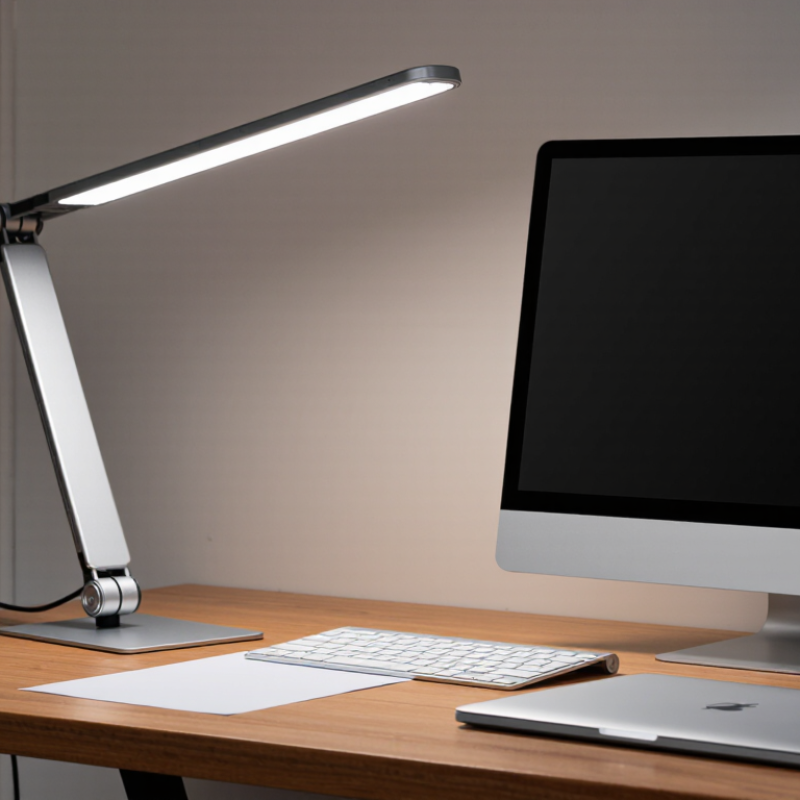
A practical evaluation should begin at eye level. Place the lamp beside your monitor, not directly behind it. Check whether a white page appears clean, whether metal surfaces produce sharp reflections, and whether shadows move across your keyboard. Look for a high color-rendering index, smooth dimming, and a suitable color-temperature range. A claimed “daylight” setting is only a starting point.
The DOE’s solid-state lighting research also emphasizes energy performance and quality metrics, not brightness alone. Therefore, the best natural light desk lamp balances comfort, accurate color, stable output, and responsible energy use. Marketing language can be attractive. Your eyes remain the better test.
“Natural light” is not a regulated promise. Treat it as a measurement question, not a lighting slogan. Check the lamp’s spectral power distribution when available. A broad, balanced spectrum usually renders colors more honestly than a narrow white LED. The phrase “full spectrum” alone proves very little.
CRI measures how accurately light shows colors compared with a reference source. For reading, drawing, or product inspection, look for CRI 90 or higher. Check the R9 value too. R9 indicates how well the lamp reveals strong reds, including skin tones and printed graphics. A high general CRI can hide weak red performance. That detail matters.
CCT describes color appearance in kelvins. Around 4000K to 5000K often feels clear for daytime desk work. Around 2700K to 3000K creates a warmer evening atmosphere. Your room changes the result. A cool lamp beside yellow walls may look less neutral than expected. I once trusted a “daylight” label and found white paper slightly blue. The specification was incomplete, but my assumption was worse.
Compare the lamp with plain white paper, a red notebook, and your skin. Notice whether colors look dull, gray, or unnaturally vivid. Flicker also deserves attention, especially during long reading sessions. Look for tested flicker data rather than relying on your eyes. Some problems remain invisible until fatigue appears.
A natural light desk lamp should make reading easier without turning the desk into a bright stage. IES guidance commonly places the target around 300–500 lux for reading tasks. Lux measures light reaching the work surface, not the lamp’s advertised brightness. That difference matters.
Place a light meter where your book or keyboard usually rests. Measure several points across the desk. A center reading of 400 lux can hide darker corners. Aim for reasonably even illumination, with fewer sharp changes between bright and dim areas.
The lamp should sit slightly to the side and above eye level. This position helps reduce shadows from your writing hand. It also limits direct glare from the shade.
I once set a desk lamp too close to the page. The paper looked brilliantly white, but my eyes felt tired after twenty minutes. Moving it farther away improved comfort, even though the meter showed slightly less light. That experience reminded me that lux is a target, not a complete comfort score. Check reflections on glossy pages and screens. Adjust the angle before increasing brightness.
Choose a lamp with a stable base, smooth brightness control, and a neutral daylight appearance. Color quality also deserves attention. A high color-rendering rating can make printed text and colored notes look more natural. Avoid assuming “natural light” means sunlight-level brightness. For most reading desks, 300–500 lux is a practical starting range. Personal vision, room darkness, and task detail may require careful adjustment. My measurements were not perfect, either. Recheck them after changing the lamp’s height.
Choosing a natural light desk lamp starts with color accuracy, not brightness alone. Look for a Color Rendering Index of at least 90, especially if you draw, edit photos, or inspect small details. A high CRI can make white paper look cleaner and skin tones appear more believable. However, CRI has limits. It measures selected color samples and may overlook saturated reds or blues.
TM-30 provides a broader view. Check the Rf value for color fidelity and Rg for color gamut. A high Rf, near 90 or above, suggests that colors remain close to their reference appearance. An Rg near 100 indicates balanced saturation. Very high gamut scores can sometimes exaggerate colors. That may look attractive, but it is not always accurate. I would test the lamp with a printed image, a red pencil, and a green plant before trusting specifications.
Color temperature, or CCT, is equally practical. Around 4000–5000 K offers a neutral tone for reading and long desk sessions. Light near 6500 K resembles cool daylight and can help a workspace feel alert, but it may seem harsh at night. Check the actual light.
Some lamps label CCT loosely. My own mistake was judging by appearance alone. A simple color meter or side-by-side test reveals differences that the eye quickly adapts to. Also consider flicker, glare, dimming stability, and even illumination across the page. A lamp can meet CRI and TM-30 targets yet still cause tired eyes if its beam is uneven.
Screen glare and flicker deserve more attention than color temperature alone. IES RP-1-22 recommends controlling reflected brightness, shielding, and viewing angles in office lighting. Place the lamp beside your screen, not directly behind it. A matte diffuser can soften harsh reflections on glossy displays. I still check the screen from my normal sitting position. A lamp can look comfortable from across the room, yet create a bright rectangle beside your text.
Flicker requires technical evidence. IEEE 1789-2015 describes modulation limits linked to frequency, especially around 100 or 120 hertz. For frequencies below 90 hertz, its low-risk guidance uses a modulation depth below 0.025 times frequency. This is guidance, not a universal legal limit. Ask for measured flicker data, including modulation percentage and flicker frequency. Do not trust “flicker-free” wording without test conditions. The U.S. Department of Energy’s solid-state lighting reports also treat flicker, glare, and visual comfort as key quality factors. Measurements matter.
Tips: Choose a lamp with stable output at the lowest brightness setting. Test it with your phone camera, then confirm results with a flicker meter. Keep the light source above eye level. Reduce screen reflections by about 30 degrees. My own mistake was testing for only five minutes. Longer reading exposed eye strain that the first test missed.
Choosing a natural light desk lamp requires more than comparing brightness and color temperature. I once selected a lamp that looked comfortable in a showroom, yet caused glare after two hours of reading. Now I check measurable evidence. DOE data can help verify power consumption, efficiency, and applicable energy requirements. Compare watts with delivered lumens, not watts alone. A 10-watt lamp may use less electricity, but poor optics can waste useful light.
Ask for a clear lifetime rating and its testing conditions. “50,000 hours” means little without information about temperature, duty cycle, and brightness maintenance. DOE records may support energy claims, while IEC documents can show whether the lamp follows recognized electrical and photobiological safety requirements. Look for references related to luminaire safety and blue-light exposure. A genuine report should identify the tested model, laboratory, date, and standard edition. Missing details deserve caution.
Tips: Place the lamp beside your writing hand to reduce shadows. Test it on white paper for reflected glare. Check whether brightness changes smoothly. Confirm the adapter and lamp carry suitable IEC safety documentation. Do not rely on packaging language alone. I still find product sheets confusing sometimes, especially when lifetime figures use different test methods. That uncertainty matters. Compare equivalent conditions, keep the report, and judge comfort after a real evening of work, not five minutes in a store.
| Lamp Technology | Typical Rated Life | Typical Efficacy | Typical Power for Similar Desk Brightness | Estimated Annual Energy Use* | Natural-Light Characteristics | Relevant DOE / IEC Verification |
|---|---|---|---|---|---|---|
| LED | Approximately 25,000–50,000 hours | Approximately 80–120 lumens per watt | 6–12 W | 17.5–35.0 kWh | Available in 4,000–5,000 K; high-CRI versions can provide a balanced, daylight-like appearance. | Check DOE LED lifetime and efficacy guidance; verify electrical and photobiological safety against IEC 60598-1 and IEC 62471. |
| Compact Fluorescent Lamp | Approximately 8,000–15,000 hours | Approximately 45–70 lumens per watt | 10–18 W | 29.2–52.6 kWh | Daylight color options exist, but warm-up time and color consistency may vary. | Compare rated wattage and life with DOE energy-use guidance; verify luminaire construction and electrical protection under IEC 60598-1. |
| Halogen | Approximately 2,000–4,000 hours | Approximately 15–25 lumens per watt | 25–50 W | 73.0–146.0 kWh | Usually produces a warm 2,700–3,200 K light rather than a daylight-like appearance; emits substantial heat. | Check DOE efficiency information; confirm thermal protection, enclosure, and surface-temperature requirements under IEC 60598-1. |
| Incandescent | Approximately 750–2,000 hours | Approximately 10–17 lumens per watt | 40–75 W | 116.8–219.0 kWh | Typically 2,700 K and warm in appearance; most input energy becomes heat rather than visible light. | Use DOE energy-consumption comparisons; verify lamp-holder, insulation, temperature, and electric-shock protection under IEC 60598-1. |
| Selection Dimension | Practical Target | How to Verify Before Purchase | Why It Matters |
|---|---|---|---|
| Rated lifetime | At least 25,000 hours for an integrated LED desk lamp | Read the rated life in hours and confirm whether it is based on lumen maintenance or simple failure time. | A longer rated life can reduce replacement frequency, waste, and maintenance. |
| Energy use | Prefer LED operation at approximately 6–12 W for normal desk tasks | Check input wattage, annual kWh information, and the DOE energy-use data for comparable lighting technologies. | Lower wattage reduces electricity consumption when light output is comparable. |
| Color temperature | 4,000–5,000 K for a neutral-to-daylight-like appearance | Confirm the correlated color temperature listed on the product specification sheet. | Color temperature affects visual appearance and personal comfort; it does not by itself prove safety or color accuracy. |
| Color rendering | CRI 80 or higher; CRI 90 or higher for detailed color work | Look for a declared CRI value and, where available, a detailed test report rather than relying only on “natural light” wording. | Higher color rendering generally makes printed materials, artwork, and colored objects appear more accurately. |
| Photobiological safety | Risk Group 0 or Risk Group 1 under the applicable assessment method | Request photobiological-risk information or test documentation referencing IEC 62471; avoid staring directly into high-intensity LEDs. | IEC 62471 evaluates optical radiation hazards, including blue-light and retinal exposure risks. |
| Electrical and mechanical safety | Clear compliance documentation for the complete luminaire | Look for documentation referencing IEC 60598-1, including insulation, grounding or Class II protection, stability, wiring, and abnormal-operation tests. | A lamp’s safety depends on the complete fixture, power supply, enclosure, and controls—not only on the LED module. |
| Flicker and controls | Stable output at all brightness settings | Check whether flicker measurements are provided; test dimming modes with a phone camera only as a preliminary check, not as a formal safety test. | Poorly designed drivers may create visible or invisible modulation that some users find uncomfortable. |