A good home office lamp does more than brighten a desk. It helps you read notes, review a screen, and work comfortably through changing daylight. Yet the right choice depends on your space, habits, and the tasks you do most.
A compact desk may need a narrow base or a clamp mount. A larger work surface can benefit from an adjustable arm that moves light where it is needed. Dimming controls and adjustable color settings offer flexibility, while a well-shaded bulb can reduce distracting glare. Small details matter. A switch hidden behind the lamp can become annoying during a long workday.
This guide to the top 10 best home office lamps for work compares practical features, including brightness, adjustability, footprint, and ease of use. It also considers how each style may suit different desks and routines. A lamp can look perfect online and still feel too harsh at night. That is worth remembering. No single model works for everyone, and some useful features may matter less than a steady, comfortable light. The selections below can help you narrow the options and choose a lamp that fits your workspace, rather than simply adding another attractive object to it.
When comparing the top 10 home office lamps for work, look beyond brightness claims. EN 12464-1:2021 sets 500 lux as the maintained illuminance for office tasks such as writing, reading, and typing. That figure applies to the task area, not simply the lamp’s advertised output. A bright bulb can still leave a notebook in shadow.
The same standard lists a UGR glare limit of 19 and a colour-rendering index of at least 80 for these tasks. In practice, place the lamp beside your writing hand and aim its shade so the bulb is not visible from your usual seat. Check the desk after dark, too; daylight can disguise uneven lighting. The benchmark is useful, but it is not a guarantee of comfort. My own desk still has a dim corner.
Tips: Use a lux meter app as a rough check, then confirm with a dedicated meter if precision matters. Measure at the page, with the lamp in its normal position. EN 12464-1:2021 is the reference for the 500-lux and glare criteria; CIE 117 explains the unified glare rating method. Keep the screen out of direct reflections. Small adjustment, real difference.
Comparing the top 10 home-office lamps means looking beyond maximum brightness. For reading, writing, and computer work, EN 12464-1:2021 specifies 500 lux maintained illuminance for office tasks and a Unified Glare Rating limit of 19. These are useful reference points, not guarantees that a desk lamp alone can meet the target. Room lighting, desk color, and lamp position all affect the result.
Check each lamp’s lumen output, dimming range, and shade design. Lumens describe light emitted; lux describes light reaching the desk. A high-lumen lamp can still create a harsh hotspot if its beam points directly at your eyes or reflects off a glossy screen. Diffusers and adjustable heads help, but placement matters: aim the beam across the work surface, then check for bright reflections from your usual seated position. Small changes can help.
A practical comparison should note whether each lamp offers stable low settings for evening work and enough focused output for paper tasks. Warm, dim light may feel comfortable, yet it can make fine print harder to see. Conversely, maximum brightness is not automatically better. I would compare lamps at the same desk height and measure the lit area with a lux meter, while treating phone readings as rough estimates. One limitation: manufacturers do not always publish comparable glare data, so a UGR value may be unavailable for a standalone lamp.
EN 12464-1 is a European standard for lighting in indoor workplaces, not a score that certifies a desk lamp on its own. For office tasks such as reading, writing, and data processing, commonly cited criteria include a UGR limit of 19, a minimum Ra of 80, and maintained illuminance around 500 lux. The exact requirements depend on the task and applicable edition.
UGR estimates discomfort glare from the whole lighting setup. It depends on the lamp’s brightness, viewing angle, room dimensions, and reflective surfaces. A “UGR 19” label does not guarantee comfort at every desk. Sit at your usual screen position and check whether the bulb is directly visible or reflected in the display. A small adjustment can help.
Ra 80 means colors generally appear reasonably natural, which is useful when checking charts, paper documents, or skin tones on video calls. It does not describe every aspect of color quality. Measure light on the work surface, not at the ceiling, and reassess after daylight fades. Chasing numbers alone is tempting; the real desk can still surprise you.
Maintained illuminance benchmarks for selected office tasks in EN 12464-1. These lighting criteria can help evaluate a home-office setup; they are not ratings of individual lamps.
How to read this: The bars show maintained illuminance in lux for each task. EN 12464-1 also sets a limiting UGR of 19 and a minimum colour rendering index (Ra) of 80 for writing, typing, reading and data-processing areas. UGR limits discomfort glare; Ra describes how faithfully light renders colours.
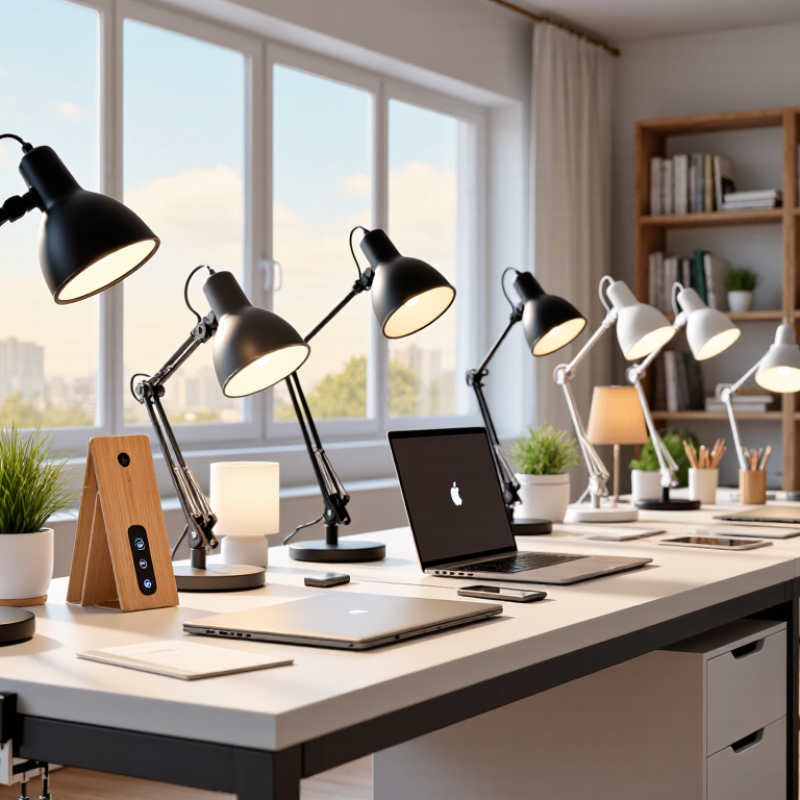
On a compact desk, a slim clamp lamp can leave more room for a notebook and mouse than a weighted base. Check the clamp depth and desk edge before choosing one; thick lips or cable trays may block installation. A narrow, adjustable arm can direct light onto paper without shining straight at the screen. Small footprint, big difference.
For a wide desk with one large monitor, choose an arm long enough to reach the keyboard from behind the display. A broad, diffusing shade spreads light more evenly than an exposed bulb, which may create bright spots on glossy screens. Keep the light above eye level and slightly to one side. Glare gets tiring.
Dual-screen setups often benefit from a lamp that swings across both work areas, but avoid placing its brightest point between the displays. Laptop users may prefer a compact task lamp with a movable head, especially when switching between typing and handwritten notes. Match the lamp’s reach to the desk, not just its appearance. Even then, shadows can linger near a wall or shelf, so test the placement after dark. A perfect setup is less common than a workable one.
A practical comparison of common lamp designs. Size, brightness, and color-temperature figures are typical ranges; check the specifications of an individual lamp before buying.
| Lamp design | Typical size or reach | Typical light output | Best desk size | Best screen setup | Best for | Things to consider |
|---|---|---|---|---|---|---|
| Compact weighted-base LED task lamp | Base about 12–18 cm wide; arm reach about 35–50 cm | About 400–800 lumens; often dimmable | Small desks, about 60–100 cm wide | One laptop or a single monitor | Focused reading and writing without taking up much desk space | Place it beside the screen rather than directly behind it to reduce reflections. |
| Long-reach articulated desk lamp | Arm reach about 60–90 cm; base commonly 15–22 cm wide | About 500–1,000 lumens; brightness and color settings vary | Medium to large desks, about 100–160 cm wide | One large monitor or two side-by-side monitors | Adjustable, broad task lighting that can be moved around screens | Check the arm’s reach and joint stability; extended arms need adequate clearance. |
| Clamp-mounted swing-arm lamp | Arm reach about 60–100 cm; clamp opening commonly about 3–6 cm | About 400–900 lumens, depending on the bulb or LED module | Small or crowded desks, about 60–140 cm wide | Single-monitor or multi-monitor setups with limited surface space | Freeing desk space while positioning light over a work area | Confirm that the clamp fits the desk edge and does not obstruct a cable tray or shelf. |
| Linear LED desk bar | Light bar about 40–80 cm long; usually sits on a weighted base | About 500–1,200 lumens; some models provide adjustable color temperature | Medium to large desks, about 100–180 cm wide | Wide monitors or dual-monitor arrangements | Even illumination across a broad work area | Check that the bar and base do not block monitor stands, notebooks, or frequently used items. |
| Monitor-top light bar | Typically about 40–80 cm long; mounts on the top edge of a monitor | About 300–800 lumens directed toward the desk | Desks of most sizes where the monitor has a compatible top edge | One flat-panel monitor; some designs fit curved screens | Lighting the keyboard and documents while keeping the desktop clear | Check screen thickness and curvature compatibility. A correctly aimed bar directs light onto the desk rather than the display. |
| Dual-head or twin-arm task lamp | Overall reach about 60–100 cm; two adjustable heads | About 600–1,200 lumens combined | Large desks, about 140–200 cm wide | Two monitors, a monitor plus paperwork, or a wide desk split into zones | Lighting two work areas independently | Allow room for both arms to move, and avoid aiming either head at a screen. |
| Architect-style drafting lamp | Arm reach about 70–110 cm; usually a weighted base or desk clamp | About 500–1,000 lumens; output depends on the fitted bulb or LED | Medium to large desks, about 100–180 cm wide | Large monitor with a separate drawing, craft, or paperwork area | Precise positioning over a specific task area | Its longer arms can be bulky; check that the design can reach the work without crossing the screen. |
| Wide-shade banker-style task lamp | Shade commonly about 25–40 cm wide; fixed or limited-adjustment neck | About 400–800 lumens, depending on the bulb | Medium desks, about 90–140 cm wide | One monitor with a nearby reading or writing area | Broad, comfortable light for paper-based tasks | A wide shade occupies desk space and may be harder to position precisely than an articulated arm. |
| Portable rechargeable task lamp | Often about 20–40 cm tall; compact base or foldable body | About 150–500 lumens; runtime varies with brightness | Small desks, shared work surfaces, or temporary workstations | Laptop or single-monitor setup | Flexible placement and use where a nearby outlet is unavailable | Check stated runtime at the brightness level you plan to use; rechargeable lamps need periodic charging. |
| Floor-standing task lamp | Typically about 140–180 cm tall, with an adjustable head or arm | About 600–1,500 lumens, depending on the light source | Small desks with little free surface, or large desks with a clear side area | Large monitor setups where desk-mounted lamps would compete for space | Keeping the desktop clear while directing light toward a work zone | Requires floor space and a stable base; position it to avoid glare on the screen. |
Selection tip: For screen-based work, prioritize adjustable positioning and glare control. A dimmable lamp with a neutral-white setting (often around 3,500–5,000 K) can suit focused tasks, while a warmer setting may feel more comfortable for relaxed evening use. Lumens describe light output, not how much light reaches a particular part of the desk.
Choosing a home-office lamp by appearance alone can leave your desk bright but your work area uneven. Use lighting benchmarks to compare practical performance. For close tasks, aim for roughly 300–500 lux on the desktop, then adjust for room daylight and screen brightness. A light meter gives a more dependable reading than a phone app, though even careful measurements cannot capture every person’s comfort.
Check whether the lamp spreads light across your keyboard and notebook without creating a sharp hotspot. Place it opposite your writing hand when possible; this can reduce shadows across the page. A flexible arm, dimmer, and shade that directs light downward make small adjustments easier. Look for low glare on your monitor, too. Tilt the screen and lamp until reflections disappear.
Color temperature around 3000–4000 K often feels suitable for focused daytime work, while a high color-rendering index can make printed colors look more natural. Flicker matters, but it may not be obvious during a quick showroom test. Try the lamp at your usual brightness and notice eye strain over a normal work session. These numbers are useful starting points, not guarantees. I still find that a technically bright lamp can feel tiring if its beam is too narrow.